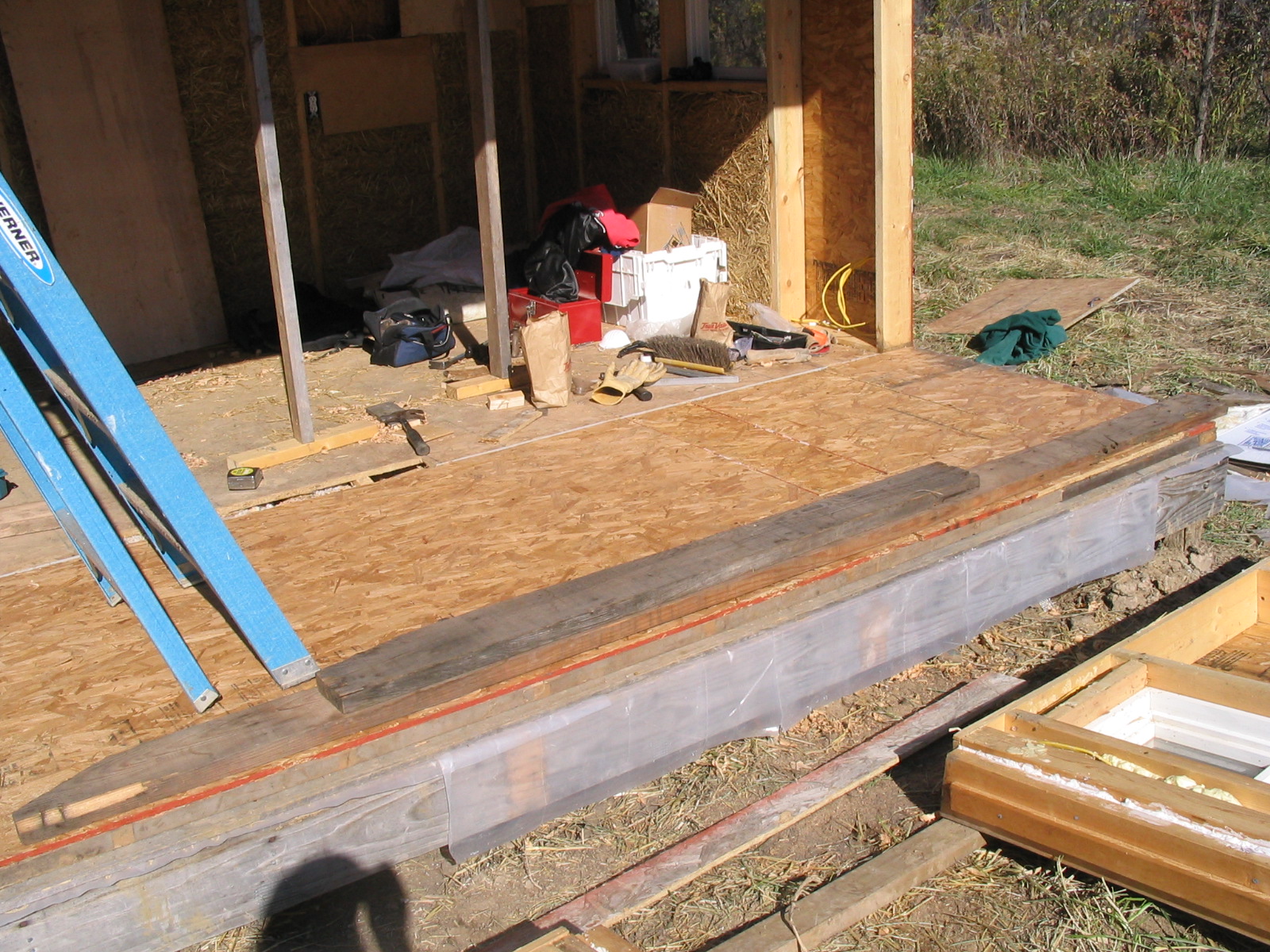
I've been continuing with the house despite the onset of cold weather. Some of the things I've been working on have been: installing the chimney and stovepipe; finishing the ceiling in the second floor; finishing the light straw insulation; plastering; and putting on a new door. The house is now almost winter proof as far as insulation, heating, and sealing up drafts.
 This is the full wall of the lower level insulated with light clay straw.
Thor puppy demonstrates the value of straw as an insulator. Being an outdoor dog, Thor has to endure the cold weather and though he doesn't know the science behind why straw is a good insulator, he is drawn to straw beds in the gardens around DR because he knows they are warmer places to sleep. The kids helped him out by piling more straw on him.
I chose fiberglass insulation for the roof between the rafters simply because it is easier than the light clay straw since the roof is not vertical, and it insulates better, which is important for the roof, where more of the heat is likely to escape. It is not the most ecologically sensitive material to use because it has a lot of "embodied energy" (meaning its manufacture requires a lot of energy), but since I had to get the house ready for winter in a short time I decided to make this concession.

After finishing the insulation. My goal was to get the stove in so I could begin lighting fires to dry out the insulation and new plaster. I finally got the chimney and stove pipe, but then we had an icestorm, which made climbing up a ladder and walking on the roof difficult as both were slick with ice. I began framing the inside rafters to hold the heavy weight of the double walled stainless steel chimney. When the weather cleared up I made the venture up to the roof and began cutting the hole and installing the chimney. After some minor snags I got everything installed.

I finished up the ceiling in the second floor by putting a vapor barrier over the fiberglass and covering it with 1/4" plywood that came with the house when I bought it. I will probably take out the plywood in the future and replace it with something more substantial later.


Before actually lighting the stove I wanted to plaster the area closest to the stove and stovepipe so it would be protected from the heat. I nailed a few blocks up on the studs to stick out from the plaster so I would have something to attach a sheet of roofing to as a heat shield (picture below).

I continued plaster the upper level and after finishing moved my bed in. The wooden boards are nailing strips nailed to the studs to allow the hanging of pictures. I really like the way the plaster looks against the woodwork.

To mix the plaster in the cold I've had to bring the ingredients inside the house and warm them with the heat of the stove before bringing them outside to mix. People don't typically mix and apply plaster this late in the season. There could be some potential problems with mold forming because it's so cold and drying could take longer. I 'm hoping that because in a wood heated house winter is such a dry season, there won't be a problem with drying out the walls at this time of year.

I put up the tin heat shield behind the stove to reflect heat back into the room and away from the straw insulated wall. When I touched the tin during a very hot fire in the stove it was cool.

The last thing I did before going away for the holidays was to put on a new door. The old one opened out and was hung crooked. I had to cut down a scavenged door to fit the small opening available. I also had to cut and shape the threshold from a 2 by 6. I plan to put a more interesting veneer on the front of the door and add another pane so that the window insulates better. For now, as long as it keeps out the cold, I'll be happy. It does not allow the draft that the other door did.

When I get back to DR I will plaster the last section of wall on the first floor and hopefully the house will be warm enough to live in. I am looking into power systems since right now there is no power in the house. I would like to cooperate with others in the area to get power, but right now there is no excess power. I may get a wind turbine and cooperate with the grain bin next door that now has only solar panels for power.