Showing posts with label chickens. Show all posts

Tuesday, November 27, 2012

Eating Locally

 
I have been gradually working towards a more and more local diet since moving to Dancing Rabbit.  I've spent large parts of the season trying to grow my own food, which is part of the reason it's taken me so long to finish building my house.  I've got the vegetable gardening down pretty well and am able to produce a lot of my own veggies throughout the season and even into the winter such that I rarely, if ever, buy vegetables from the grocery store.  I rarely buy fruit, but will stock up and preserve it when it is available locally or on farm.  Strawberries, black raspberries, grapes, and gooseberries are the only things I've been successful with so far.  A few crops like peaches, seem really difficult to grow here organically.  Pears and apples are slightly easier, but my trees are only just getting to fruiting age, and I know they have problems with disease in wet years as well.


Abenaki Calais flour corn
This season I experimented a bit with growing flour corn, with the idea that I might try to produce my own grain to take the place of the rice I buy on a regular basis.  Corn is a crop that is fairly easily grown here, can be productive, and can be stored for use throughout the year.  I do eat corn a lot in my diet already and imagine I could shift my diet pretty easily to have it replace rice.  People like Michael Pollan rant against Americans being entirely made of corn because of the large amount of high fructose corn syrup found in the foods they eat.  I don't think my desire to increase the corn in my diet is deserving of the same critique.  Corn was a staple food of Native Americans living all over North America for thousands of years, and although they didn't chemically alter it to extract corn syrup, they did chemically alter it to make it more nutritious in some ways, by a process known as nixtamalization.

Nixtamalization involved boiling dried corn kernals with wood ash and leaving them overnight.  Then they would wash out the ash and grind the corn into a wet flour.  The boiling and soaking with ash caused the corn to break down somewhat, making it easier to grind.  It also gave the corn a distinct flavor that was the result of the combination of the corn and the lye in the ash.  If you've ever tasted the difference between corn in cornmeal or cornbread and that in tortilla chips or tamales, you probably know the flavor I'm talking about.  Above is some of the corn I grew this season.  I ended up with about a gallon of grain from a small bed of corn, and I plan to nixtamalize it and use it to make tortillas and tamales.  I am just waiting on getting the right kind of flour mill for the wet corn kernals. I could dehydrate the corn after nixtamalizing it and then grind it into dry flour, but I've heard it is much better to make food from the freshly prepared kernals.   In Nicaragua, the women get up at the crack of dawn every day to make tortillas.  I remember watching the family that took care of the farm I worked at nixtamalizing corn over an open fire. Maybe someday I'll have enough corn to do this on a regular basis.

Tuesday, November 8, 2011

Gathering Food

It's been a while since I last posted something here, so I'll probably just try to do some posts bit by bit to describe the busy season I've had raising veggies, tending the vineyard, and finishing building my house. Fortunately I've been taking pictures, so there is some record of what I've been doing. I just haven't taken the time to update the blog this season. I wish I could be as prolific in my blog posts as Ziggy.

This season, there was a bounty from the garden in many ways.  Because I end up with so much of some crops I try to come up with ways to preserve what I can't eat right away so I can extend the bounty through the rest of the year.  Not so long ago, before the advent of refrigeration, everyone grew their own food and knew special ways of preserving it for the rest of the year.    Pickling in brine was a great way of keeping veggies edible for the winter and inspired so many delicious new foods.  These foods were fermented like saurkraut and could be stored without refrigeration in a cellar for many months.  One pickle that I like to make is the Korean kimchi, which is made with Chinese cabbage or radish, scallions, really hot peppers, and if desired, small fish like anchovies.  I like hot pickles and one of my favorites is a hot pickle mix of cucumbers, carrots, and hot peppers.  In this pickle everything becomes infused with the heat of the peppers adding a kick to the cukes and carrots.  This was a good year in the hoop house for pickling cukes, so I made a big batch of hot pickle mix.

Wednesday, September 22, 2010

Monarch Butterflies Take Over

I've continued this busy building season working on the house. I'm making progress on the earthen floor. The light clay straw has taken way too long to dry and is setting back the entire project, unfortunately. At least now I know it needs at least a month to dry. I've even resorted to pushing boards underneath the layer of light clay straw to prop it up and allow air flow underneath. This worked but it did loosen the straw somewhat. I couldn't wait any longer for it to dry though.

The monarch butterflies flooded our fields this year to feed on nectar from the white snakeroot. I don't know what was going on with the migration or why they are suddenly in such great numbers this year. I've never seen so many in one place before. All the white flowers in the picture below are white snakeroot and each plant has 5-7 monarchs on it. There have got to be thousands in our fields.


Tuesday, September 15, 2009

The roof is on

We've continued with work on the house. It is definitely our highest priority and taking most of our time though we still try to fit in a little canning on the weekends. The weather lately has been ideal for building.

We've made a lot of progress on the framing and have finished tinning the roof. The house has fully taken shape. We have wired it as well and Mary Beth is insulating the south wall with light clay straw. We started the baling in the last few days, and have made some progress on the first floor. The cistern went in as well and I'm working on the plumbing to it. I don't have time to update this blog fast enough to keep up with our progress. Unfortunately, it seems unlikely that we will have the house ready to live in by the winter. We would like to take our time and make sure we do it right and there is really too much to do before winter to get it ready to live in.


These clowns have been helping us build our house lately. They are Dan and Danielle, new residents of DR. They do performance art and Dan is a trained clown. They are fun to have around.


We've also been finding some time to continue canning veggies. Lately tomatoes have been the major crop. Sauce, salsa, juice. We are stocked for winter.


I haven't shown the chickens lately so here are a couple pics of them. I think I've decided to keep most of them through the winter so we can have eggs next year. I'd originally planned to eat the chickens before winter, but now I'm thinking I'll like having eggs.


Wednesday, June 10, 2009

Chicken tractor

We went to the flea market aka The Dog 'n' Gun in early May and I bought 16 chicks from a hatchery there, 7 Barred Rocks and 9 Rhode Island Reds. At first we had to keep them in a box in the house because it was still a little too cold outside for them. During the day we put them in the coldframe where I'd started many of my vegetable plants.

That seemed to keep them warm enough. Usually people keep chicks in a brooder and try to maintain a temperature of about 85-90 degrees for the first couple weeks of their lives. The brooder has a heat lamp in it much like the kind they use to keep fast food hot. The lamp takes the place of a hen who would, under more natural conditions or in the old days, keep the chicks warm. I would love to have a hen to sit on the chicks but "broody hens" are hard to come by these days apparently. Heat lamps have taken their place for the sake of convenience and mass production and broodiness has been bred out of most breeds because it is not desirable in the world of mass-produced eggs. Anyway, since those lamps use at least 500 watts of power I had to find an alternative. I just kept them in a box with a compact flourescent lamp in it. They stayed at around 80 degrees in the box at night and though they huddled together under the lamp, they made it through just fine at that temp.

Eventually they grew more feathers and were insulated enough to be outside in the chicken tractor all night. The nighttime temperatures eventually warmed enough for them to be fine outside. Now they are close to their adult size and have been in the tractor out to the vineyard for about a month. So far I've had no problems with predators, which was my main worry. The chickens are still making chick sounds and the roosters have yet to crow, but I expect they will start sounding like chickens soon. They are doing a great job of fertilizing the vineyard. At first I was feeding them chick starter, which is prepared food, but now I've switched them over to local organic grains, like barley, corn, and flax. They love the clover I planted in the vineyard rows and can't wait to get into the fresh pasture each time I move the tractor.


Last week I was able to work more on the soffit on Wisteria Lodge and finally finished it. That meant I could finish the arbor on the front of the house. Mary Beth came up with a design for the cross pieces and I installed them, so now the arbor is done. Just in time too, because the wisteria vine is rapidly making its way up the arbor post. It still has about a foot and a half before it reaches the cross pieces.


The garden is mostly planted. I got the ok to rent additional garden space on the south side of Skyhouse garden and with the hard work of my work exchanger Charles, we have sheet mulched, fenced, and planted almost the entire new space already. Sheet mulching allows you to quickly create a garden without having to till up the soil. You just mow the wild plants, cover the ground with cardboard, and put straw mulch on top. To plant, you just cut a hole in the cardboard and drop your plant in. The space went from a wild field to a garden in a very short time. The space had actually been someone's garden in the past, but hadn't been tended for several years. I decided to put the tomatoes, squash, cukes, and beans there because they are easier to plant in a sheet mulched garden.


We've been harvesting tons of strawberries lately. The small beds we have just keep producing. We've made jam, syrup, and strawberry ice cream. The ice cream was really good because Mary Beth used only cream to make it. It was a hit with everyone here and was quickly eaten. We are probably going to make strawberry wine with the next harvest.

Another crop we've been enjoying lately is salad greens. It's nice to have fresh local veggies again. Soon we will be adding other veggies and herbs to our diet.

Mary Beth created an herb spiral in the garden recently. She'd been inspired by the herb spiral we saw at the Hostel in the Forest. Hers looks really good now, and the many herbs she's planted are taking hold well. Rosemary, lemon grass, nasturtium, oregano, marjoram, creeping thyme, parsley, cilantro, chamomile, thai basil, sweet basil, and epazote, a mexican herb much like oregano used to flavor beans. We'll be doing a lot of drying of herbs so we can use them year round.


The vineyard is growing like crazy in this rain we've been getting. Some vines are already almost 6 feet tall, which is as tall as I want their main trunks to be.

Monday, April 27, 2009

Spring in Missouri

It's been busy ever since we got back as things are warming up and we are gearing up for the gardening and building season. I have a long to do list and with the help of a couple of work exchangers I have been ticking things off. It's really nice to have another person around to help me with gardening so I can focus on other projects.

My little starts have been going for awhile now. In the absence of power for flourescent lights and a greenhouse I have been using a simple coldframe to start my seedlings and it seems to be working great so far. I put the plants out in the coldframe on warm days and bring them in on nights when it is supposed to freeze. The only problem I've had is mice or rats or something coming in and eating a bunch of the brassicas. Fortunately I had already planted out most of the ones I wanted, so it wasn't a total loss.


While my work exchanger, Adam, was working in the garden, I was busy last week building a chicken tractor for my chicken experiment. I plan to put the chickens in the vineyard to naturally fertilize the grapes. The chicken tractor is just a mobile chicken coop. You move it daily so the chickens can fertilize a new area every day. Moving them also allows them to graize new pasture and forage for bugs. Because the chickens are foraging they don't require as much feed and the food they get is much more nutritious. If you've ever had farm fresh eggs, you may know that eggs from the grocery store are literally pale in comparison. When chickens eat bugs and graize pasture, they get all the vitamins and minerals they need to make bright orange yolked eggs that are much more nutritious than factory farmed eggs. The taste is also starkly different. I probably won't be keeping my chickens until they are able to lay eggs because I don't have anywhere to overwinter them yet. I plan to eat them all before winter, that is if something doesn't come and eat them first. In the future if raising chickens seems worth it, I will keep them over winter and get eggs in addition to manure.


We thought that maybe the rain wasn't going to come this spring, but after getting a few garden beds worked up and planted. the deluge came. The village turned to mud and made us all want to speed up the roads project which will turn our wood mulch roads to gravel and grassy pavers and divert rainwater in a more intentional manner. But for the roads project to begin, the rain has to stop for a good while.

The garlic has been growing swiftly and the peas, spinach, and lettuce are up. The strawberries I planted last spring are flowering abundantly and little fruits are forming. I can't wait to have fresh salad and strawberry-rhubarb treats. We will probably make jam.


This season I decided to really raise my garden beds up to combat the spring monsoons. I'm using old barn beams to divide the beds and give me something to walk on. With the help of my work exchangers Adam and Charles I have been adding topsoil and composted manure to the beds. The topsoil scraped off the ground during the digging of the foundation has been sitting in a pile on my warren for a year and a half and I'm determined to get rid of it this season by redistributing it to other places. That will free up the space in front of the foundation for construction. The gardens look great now that the spring rains have taken a rest for a bit and we've been able to work up the remaining beds. I'm finding that the garden is too small for what I want to plant so I'm going to be renting additional garden space for the tomatoes, peppers, eggplant, and squash. It seems like a lot of space, but the additional space will be gardened using a no work system that involves sheet mulching and planting directly into the mulch. I'll be explaining this system when I get to it later in the season.


The perennials I planted a while ago are coming back again this spring and flowering, making the house look even more quaint than it already does. I love how the irises smell.


Mary Beth and I have gone out morel hunting a couple of times already and found a couple dozen altogether. They are best sauteed with garlic in butter (cream from the local dairy hand churned in our butter churn).

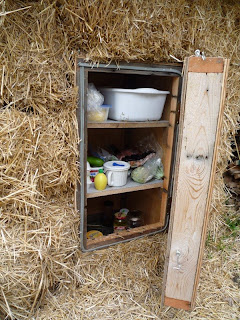
I've been experimenting a little more lately, this time with refrigeration. I've built a strawbale icebox, so we can keep our food cool in the summer. It's just a wooden box, surrounded on three sides with strawbales, and a door insulated with light clay straw like the kind used in the walls of Wisteria Lodge. We get blocks of ice from the butcher and put them on the top shelf. I'd left the bottom open to the ground but now I'm realizing that the ground is probably sucking the cold out of the icebox and I plan to insulate the bottom too. Another improvement will be foil on the inside to reflect radiant heat. Hopefully with these improvements the icebox will retain cold better.

The grapes in the vineyard are popping up with renewed vigor. After getting established last year, they have plenty of roots and are ready to go. I'm giving them a little help by protecting them from deer grazing with chicken wire cages. I haven't been able to determine the survival rate of the vines from last year to this, but it is very high. I counted around twenty vines out of about 200 that may not have made it. I say may not because with grapes you can't always tell. When I came here I brought a lot of grape plants with me, too many in fact, and I ended up giving them away. Someone here took a bunch and kept them in a shed for a few weeks before planting them out. They waited and waited for weeks and there was no sign of life. It must have been about a month and a half later that a really strong shoot poked out from underground.

I'm excited about the potential for the vineyard. I also plan to visit another Missouri vineyard in June to take cuttings of two varieties I have had difficulty finding from a nursery. I want to add a couple more rows this year.

The clover I planted last fall had trouble getting established, but I replanted it a few weeks ago and it is taking over. I expect the vineyard rows will be carpeted with clover by the end of the season. This cover crop is part of my effort to improve the soil in the vineyard, which before I began was pretty depleted. Decades of conventional corn and soybean farming on the rolling terrain led to erosion and a basically lifeless soil. It will take time to restore fertility and the balance of microbes and fungi. We just got some composted manure from a local farm and dressed the vines to give them a little boost. I will probably get some more and spread it throughout the rows later in the season.